Reduce Property Maintenance Costs: Management's Playbook
Reactive maintenance inflates costs, emergency repairs cost three to four times more; so shifting to preventive maintenance for HVAC, roofing/gutters, plumbing and electrical, backed by benchmarks from BOMA and IREM, can cut repair spending 30–40%.

Reactive maintenance is one of the most predictable budget killers in property ownership, and one of the most common reasons landlords struggle to reduce property maintenance costs year over year. When a system fails without warning, you pay emergency labor rates, deal with tenant disruption, and lose any negotiating leverage you might have had with a scheduled job. Published facility management benchmarks consistently put the cost of emergency repairs at three to four times more than the same work done on a planned basis. That gap represents real money landlords lose every year, and with the right approach, much of it is preventable.
Shifting from reactive to preventive maintenance can reduce total repair costs by 30 to 40 percent, based on published facility management benchmarks from organizations like BOMA and IREM. For a landlord spending $25,000 a year on maintenance, a 30 percent reduction translates to $7,500 in annual savings, not from cutting corners, but from changing how and when repairs happen. This guide walks through the specific levers: scheduling, budgeting, vendor management, documentation, and payment verification. Start with whichever section maps to your current biggest pain point.
1. Build a preventive maintenance schedule that actually pays for itself
How to reduce property maintenance costs with a preventive care cadence
The four systems that generate the most expensive emergency repairs are HVAC, roofing and gutters, plumbing, and electrical. These are also the four systems where preventive servicing delivers the most dramatic cost difference. A professional HVAC tune-up typically runs $75 to $150 twice a year, based on widely published consumer cost estimates. A full unit replacement, by contrast, can run $5,000 or more. Skipping the tune-up to save $150 is a trade that rarely ends well.
A practical scheduling cadence does not need to be complicated. Monthly tasks cover the basics: change HVAC filters, test smoke and carbon monoxide detectors, and do a quick visual check for leaks or pest activity. Quarterly, schedule plumbing checks, gutter cleaning, and exterior walkthroughs. Annually, flush water heaters, inspect roofing and siding, and test electrical panels. Add seasonal tasks for winterization and cooling system prep before each season change. This cadence covers the rental property maintenance costs most commonly driven by deferred work, and it keeps your units in better condition for tenants throughout the year. For a deeper look at typical line-item expenses, see an overview of rental property maintenance costs.
Owners and managers who run formal bi-annual property inspections consistently report fewer emergency maintenance issues and lower emergency repair spending, industry benchmarks suggest reductions in the range of 30 to 40 percent in both categories. That's not because inspections fix anything by themselves. It's because catching a small leak early costs far less to address than discovering it after it has become a ceiling replacement. Pair your scheduled maintenance with those inspections and you have a system that generates real early warnings, not just a checklist.
2. Set a maintenance budget that reflects your property's actual risk
The 1% rule, budgeting 1% of property value annually for maintenance, is a reasonable starting point for newer, well-maintained units. For properties older than 15 to 20 years, it consistently falls short. A more honest range is 1 to 4% of property value annually, with older properties sitting toward the higher end. The square-foot rule ($1 per square foot per year) tends to produce comparable estimates and is often easier to apply across a multifamily portfolio where individual unit values are harder to track.
The 50% rule deserves a specific clarification here because it gets misapplied constantly. The 50% rule is an underwriting shortcut that allocates half of gross rental income to operating expenses, including taxes, insurance, and management fees alongside repairs. It is not a maintenance reserve calculator. Using it to set your repair budget means you're lumping insurance premiums and property taxes into the same bucket as your HVAC fund, which produces a number that won't tell you much when a water heater fails. Your per-unit repair and reserve allocation needs its own line, separate from operating expense estimates.
For multifamily properties, per-unit reserve benchmarks of approximately $1,000 per unit for repairs and $300 per unit for replacement reserves serve as useful starting anchors. Adjust those figures upward for older buildings, high-turnover units, or properties with deferred maintenance history. The cost per unit in multifamily is often lower than single-family because shared infrastructure spreads expenses across more doors, but that advantage disappears quickly if shared systems like elevators or central HVAC are aging and underserviced.
3. Negotiate vendor agreements that protect your margins
Knowing the rate ranges before a quote arrives gives you a real negotiating anchor. General handyman work nationally averages $50 to $125 per hour, with self-employed providers near the lower end and corporate or franchise providers at the top. Licensed electricians run up to approximately $120 per hour; plumbers and HVAC technicians run up to around $150 per hour in most national cost guides. High-cost metros like New York, San Francisco, and Seattle tend to push those figures higher, so adjust your baseline expectations accordingly. For a practical pricing reference, review a detailed guide on how to price handyman jobs.
The most reliable way to reduce per-job costs is bundling multiple work orders into one site visit. Contractors charge for travel and minimum-service fees on every dispatch, so consolidating three small jobs into one visit can cut total billing by a meaningful amount without negotiating the hourly rate at all. Committing to volume through a recurring vendor relationship gives contractors a reason to offer discounts, predictable, repeat volume is worth a discount to most contractors. Requesting flat-rate pricing on repeatable tasks (filter changes, gutter cleaning, pest control treatments) removes the risk of hourly billing that runs long. And getting two or three quotes before awarding any job, even routine ones, keeps your vendor relationships competitive.
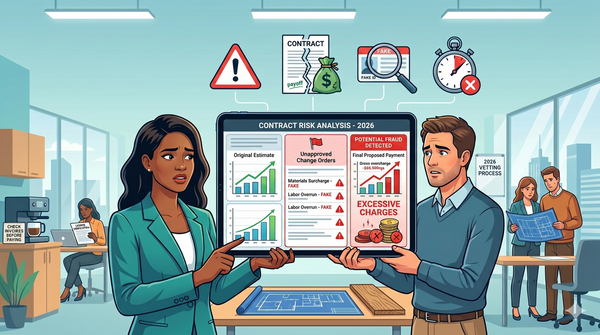
Watch for common billing patterns that inflate costs without obvious red flags. The most frequent offenders are:
- Hourly overbilling that stretches simple jobs beyond reasonable time
- Material markups that were never disclosed upfront
- Undocumented change orders for scope that should have been included originally
- Invoices for work that was never fully completed
Routine, small-value repairs are where these patterns appear most often because landlords are less likely to scrutinize a $300 invoice than a $3,000 one. Building a habit of requesting itemized invoices and comparing them to the original quote catches most of these issues before they become a pattern, and is one of the more underrated ways to reduce property maintenance costs without changing vendors at all.
4. Use documentation as a cost-management tool, not just paperwork
Owners and managers running maintenance through email threads, text messages, and spreadsheets lose money in specific, measurable ways. They miss recurring issues that signal larger problems because the history is scattered across inboxes. They approve duplicate repairs because there's no single record of what was already done. They can't prove work was completed when a dispute arises. A landlord with a documented inspection trail catches a slow drain before it becomes a sewer backup. Without that trail, they absorb the emergency repair cost and potentially the tenant complaint that follows.
Property management platforms, what the industry increasingly calls CMMS for property management, log every maintenance request, inspection, and repair in one place, creating an early-warning system out of your own data. Tools built around this workflow, like Casalink, track maintenance history across an entire portfolio and, according to the platform's own documentation, surface predictive alerts when patterns suggest a system is trending toward failure. See an overview of Property Management Features that support this approach. A full audit trail on every job, covering quotes, photos, technician notes, and invoices, transforms records from a compliance burden into a cost management tool. Knowing "the HVAC in unit 4 was serviced twice last year and is overdue for a replacement component" versus finding out when the unit fails in August is the difference between a scheduled repair and an emergency callout at double the rate.
5. Verify work before any payment clears
Many landlords release contractor payments based on a phone call or a text saying the job is done. No verification step means the cost of a poor or incomplete repair comes due later: a callback, a tenant complaint, or a repeat failure that's more expensive to fix the second time. Across a portfolio, this pattern inflates the effective cost of every repair. A job billed at $400 that requires a $250 callback is actually a $650 repair, and it never shows up that way in the books.
Casalink offers an AI photo verification feature that, per the platform's documentation, holds contractor payment until submitted photos are reviewed against the original repair request. This step removes the guesswork from work completion and creates an evidence-based record on every job, including the original request, the contractor's quote, inspection photos, AI scan results, and the final invoice. For landlords managing properties remotely or across multiple units, it provides accountability comparable to being on-site, without the logistics of showing up for every job. According to Casalink, this verification layer can also help identify contractors who deliver inconsistent work quality, which supports lower repeat-repair costs across a portfolio over time.
For remote landlords especially, this matters beyond just fraud prevention. The diaspora landlord managing properties in another state, or an overseas property owner managing assets back home, faces a structural trust problem that no phone call or text can fully solve. A verifiable, timestamped photo record tied to the original repair scope closes that gap in a way that manual follow-up never can. It's one concrete approach to reduce building maintenance expenses that scale with portfolio size rather than requiring more oversight hours.
Putting it all together
None of these strategies require a major operational overhaul. Build a preventive maintenance schedule focused on the systems that fail most expensively. Set a maintenance budget that reflects your property's actual age and condition rather than a generic rule of thumb. Negotiate vendor rates with volume commitments, bundled visits, and flat-rate pricing on repeatable tasks. Keep documentation that creates early warnings. Verify work before payment clears. For additional best practices comparing reactive and preventive approaches, consult resources on preventive vs. reactive maintenance.
Each of these moves helps reduce property maintenance costs in a different way. Some save on individual repairs; others prevent the category of emergency spending that wrecks quarterly budgets. Together, they shift your portfolio from reactive and unpredictable to structured and manageable. The landlords who consistently spend less on maintenance aren't luckier, they're more systematic about when and how they spend. For deeper dives and case studies, check our Property Management Blog.
If you want a single platform built to handle scheduling, records, contractor coordination, AI-verified payments, and portfolio-wide maintenance history, Casalink is worth evaluating if maintenance costs are consuming more time and budget than they should. You can explore Solutions for Owners and Managers, and if you want to estimate the software ROI before committing, try a property maintenance software ROI calculator to model savings based on your portfolio.