How to Spot Contractor Fraud Before You Pay (2026 Guide)
Property managers lose $250,000 per fraud incident on average. Learn 7 red flags that signal contractor fraud, a task verification framework that catches incomplete or fabricated work before payment, and how AI photo verification is replacing manual inspections.
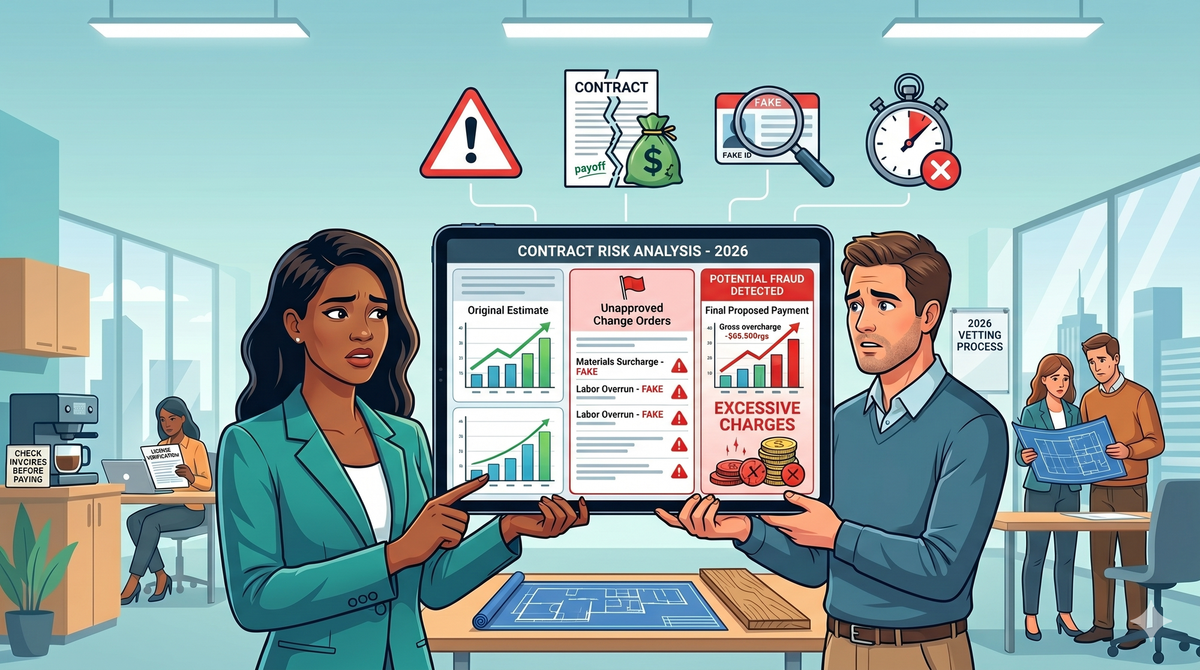
That maintenance job your contractor says is done, is it actually done?
Not "did they send the invoice" done. Actually done... properly, at the right location, with real materials, by a real person.
If you manage multi-unit properties, this question should keep you up at night. Because the numbers say you've probably already been burned.
The median loss from a single construction fraud incident is $250,000, 72% higher than the global fraud average. Six out of ten property managers have experienced fraud in the past two years. And the average fraud scheme runs undetected for 12 months.
Here's the core problem: traditional fraud detection focuses on invoices. But a fraudulent invoice is the last step in the scam. By the time you're reviewing the bill, the damage is already done.
The real question isn't "Is this invoice legitimate?" It's "Was this work actually completed?"
In this guide, you'll learn:
- Why invoice-level checks alone aren't enough
- 7 red flags that signal fraudulent or incomplete work
- A verification framework that catches fraud before payment
- How AI-powered task verification is replacing manual inspections
- What to do if you've already been scammed
Let's break it down...
Why Property Managers Keep Getting Burned
Contractor fraud goes beyond padded invoices. The most damaging fraud is work that was never done, or done so poorly it needs to be redone.
And property managers are uniquely exposed.
Multiple properties mean multiple blind spots. Managing a condo complex, an apartment building, or a portfolio of commercial spaces means coordinating with dozens of contractors across plumbing, electrical, HVAC, landscaping, and general maintenance. A contractor who cuts corners on one building can replicate the pattern across your entire portfolio before you notice.
You can't be everywhere at once. Whether you own a 50-unit condo complex, a commercial office building, or a portfolio of apartment blocks across multiple cities, you physically can't inspect every repair. You're relying on a contractor's word and photos that the work was done. That's hardly a reliable verification. Anything could be doctored these days...
Urgency kills diligence. A burst pipe at 2 a.m. doesn't leave time for competitive quotes or site visits. Emergency repairs create pressure to approve fast and verify later. Experienced scammers know this, they inflate scope and cost when your guard is down.
Trust compounds the problem. Long-term contractor relationships mean invoices get rubber-stamped. The maintenance company you've used for three years? They know exactly how little oversight you apply. Research shows that most fraud is discovered through tips, hardly audits, which means it often goes undetected until someone speaks up.
Scale makes it worse. The more units you manage, the more contractors you coordinate with, and the harder it becomes to maintain consistent oversight. A contractor who inflates costs by $300 per job across a 100-unit estate just cost you $30,000.
7 Red Flags That Signal Contractor Fraud
Not every questionable job is fraud. But if you see these patterns, slow down and investigate before you pay.
1. No Before-and-After Photo Documentation
This is the single biggest red flag. If your contractor can't produce timestamped photos showing the problem before the repair and the completed work after, why not?
Professional contractors document their work to protect themselves and justify billing. This is especially critical for hidden work: plumbing behind walls, electrical in ceilings, roofing repairs you can't see from the ground.
What to look for: Timestamps and GPS data on photos. A photo without metadata could be from any job, any location, any time.
2. Visual Inconsistencies in Submitted Evidence
When contractors do submit photos, look carefully. Do the before and after images actually tell a consistent story?
Red flags include:
- Before photos showing minor damage but after photos suggesting major work was done
- Multiple after photos that contradict each other (one shows a patch job, another shows a full replacement)
- Photos that appear to be from different locations or different times of day
- Stock-looking images or photos that seem too clean for an active work site
3. Vague Descriptions and Round Numbers
A legitimate repair involves specific materials, quantities, and labor hours. "Miscellaneous plumbing repairs — $2,000" is not a description. Real costs often look like "$47.99 PVC fitting × 3, 4.5 hours labor at $85/hour."
Round numbers and vague line items often mean someone is fabricating charges rather than documenting actual work.
4. Resistance to Independent Verification
Suggest having another contractor verify the work. A confident contractor welcomes a second opinion. One who's cutting corners or fabricating repairs will push back aggressively, make excuses, or try to rush you past the verification step.
5. Missing Credentials or Unverifiable Business
Every legitimate contractor should have a verifiable business license, insurance, and (depending on jurisdiction) a bond. In Canada, check provincial licensing databases. In Nigeria, verify CAC registration and relevant trade certifications.
Contractors who resist providing credentials or whose information doesn't check out shouldn't be touching your property.
6. Pressure Tactics and Artificial Urgency
"This needs to happen today or the damage will triple." While genuine emergencies exist, be skeptical of any contractor who creates urgency specifically to prevent you from verifying their work or getting a second opinion.
7. Pattern Anomalies Across Properties
This one's hard to catch manually. If the same contractor charges 30% more for identical repairs at different properties, or if similar "emergency" repairs keep happening at suspiciously regular intervals, you may have a systemic fraud problem.
The Task Verification Framework: Go Beyond Invoices
Checking invoices catches billing fraud. But the real money is lost on work that wasn't done, was done poorly, or was done with substandard materials. Here's a verification framework that catches all three.
☐ Require timestamped before-and-after photos. Non-negotiable. Every task should have documented visual proof of the starting condition and completed work. Photos should include metadata: timestamp, GPS location, and device ID.
☐ Match photos to the actual property. Does the background in the photo match the property? Are the fixtures, wall colors, and layout consistent with what you know about the unit? A contractor reusing photos from another job will slip up on these details.
☐ Verify the repair methodology. A "repaired bathroom tile" could mean anything from re-grouting (a $50 fix) to full tile replacement ($500+). The photos and description should clearly show what was actually done — new materials, proper technique, professional finish.
☐ Check for contextual consistency. If a contractor claims to have replaced a water heater, you should see the old unit removed, the new unit installed, and evidence of proper connections. Tools and materials visible in progress photos add credibility.
☐ Cross-reference with maintenance history. Was this repair actually needed? If the same component was replaced six months ago, something doesn't add up.
☐ Confirm with tenants. A quick check-in with the tenant; "Was the repair completed?", adds a free verification layer that many property managers skip.
☐ Review the work quality, not just completion. A task marked "complete" might still be unacceptable. A patched wall with visible cracks, a "cleaned" pool that's still green, a "serviced" generator that wasn't actually run, completion isn't the same as quality.
How AI Task Verification Is Changing the Game
Manual verification works for a handful of properties. It falls apart at scale. When you're managing a condo complex, an estate, or a portfolio of commercial buildings with hundreds of maintenance tasks per month, you physically can't inspect every job.
This is where AI-powered task verification is making the biggest difference.
Here's how it works in practice:
A contractor completes a job and uploads before-and-after photos directly through a platform. Instead of a property manager manually reviewing every image, AI runs forensic analysis automatically:
Visual analysis: Computer vision compares before and after images to confirm the reported issue was actually addressed. It can detect whether a broken gate hinge was genuinely repaired, whether pool water went from green to clear, or whether a "deep clean" was actually just a surface wipe.
Metadata verification: The system checks GPS coordinates, timestamps, and device IDs on every upload. This prevents the oldest tricks in the book; reusing photos from other jobs, submitting screenshots, or uploading images taken at a different location.
Quality scoring: AI assigns a work quality score based on the visual evidence. High-confidence verifications get auto-approved. Low-confidence results get flagged for human review, so managers only deal with exceptions, not every single task.
OCR for equipment monitoring: For specialized tasks like generator servicing or fuel delivery, AI reads mechanical hour meters and fuel gauges in photos to verify that equipment was actually operated and that fuel quantities match what was billed.
Pattern detection across portfolios: AI catches what manual review can't; the same contractor consistently delivering lower-quality work at remote properties, or subtle billing patterns that suggest systemic fraud.
This "Proof of Work" approach flips the traditional model. Instead of trusting contractors and verifying invoices after the fact, payment is only released once the AI confirms the physical work meets the required standard. Contractors who do quality work get paid instantly. Those who don't get flagged.
This is the approach Casalink is built on. AI-verified proof of work for every maintenance task, with payment tied directly to verified completion. Whether you own a 200-unit condo complex, an office building, or a portfolio of apartment blocks, you get consistent verification across every property without being on-site.
What to Do If You've Already Been Scammed
Discovering contractor fraud is frustrating. Acting quickly limits the damage.
Document everything immediately. Gather all photos, contracts, communications, and payment records. Screenshots of messages are admissible evidence in most jurisdictions.
File formal complaints. In Canada and the US: provincial/state contractor licensing boards, Better Business Bureau, and consumer protection agencies. In Nigeria: Consumer Protection Council (CPC) and relevant state agencies.
Notify your bank or payment provider. Dispute charges immediately if payment was made via card or bank transfer. Many banks have fraud protection windows, act fast.
Consult a lawyer for significant losses. Many jurisdictions have small claims courts designed for contractor disputes. Some offer triple damages for proven fraud.
Implement a verification system going forward. The most expensive fraud is the one that keeps happening. Whether you adopt a manual photo verification process, hire an oversight firm, or use AI-powered task verification, the goal is the same: never release payment without proof that the work was actually done.
The Bottom Line
Contractor fraud thrives on three things: scale, urgency, and trust. As a multi-unit property owner or manager, you're exposed to all three.
But the real shift is this: the industry has been fighting the wrong battle. Checking invoices catches billing fraud. Checking the actual work catches everything else.
A consistent verification process requiring photo evidence, checking metadata, scoring work quality, catches the vast majority of fraud before money leaves your account. AI makes this possible at scale, but even a manual photo verification habit will dramatically reduce your risk.
The key is making verification a requirement, not a request...
Own or manage multiple properties and tired of wondering if the work was actually done? Casalink uses AI to verify every maintenance task through before-and-after photo analysis, GPS and timestamp checks, and automated quality scoring. Contractors get paid when the work is proven, not just claimed.