Office Complex Operations at Scale: What Actually Changes When You Manage More Than One Building
Managing one office building and managing five are different jobs. One runs on familiarity. The other requires systems.
There is a version of facilities management that works entirely on instinct. You know the building. You know the cleaning crew, the generator technician, the elevator guy who picks up on the second ring. You know which tenant calls every Friday and which one never calls at all. You carry the whole operation in your head, and it works because you are always there.
That version runs out around building three or four.
At some point, familiarity stops being a management strategy. The instinct that served one building starts creating gaps across five. Contractors miss service windows you cannot track. CAM charges get disputed because no one documented what was done in the common areas or when. Tenants in Building B get a different standard of service than the ones in Building A, and they notice. Boards ask for reports that take three days to compile manually.
The challenge of commercial office operations at scale is not about physical complexity. Most of the tasks stay the same. The challenge is organizational: how you coordinate, document, verify, and report across multiple sites simultaneously, without being physically present at all of them.
The Jump from One Building to a Portfolio Is a Systems Problem
A single well-run office building can operate on a strong facilities manager and a good vendor relationship. At this size, gaps get caught quickly because the feedback loop is short. When something goes wrong, the manager finds out the same day.
A portfolio of buildings breaks that feedback loop. The manager cannot walk every floor every day. Problems that would have been caught on a routine inspection at building one stay hidden at buildings four and five until a tenant complaint forces the issue.
The operators who scale commercial office portfolios successfully share one characteristic. They build systems before they need them, typically while managing two or three buildings, before the gap between what they know and what is actually happening becomes unmanageable.
Those systems cover three areas: work coordination, financial accountability, and reporting. Everything else in scale operations is downstream from these three.
What Breaks First: Vendor Coordination
Managing one building with a small vendor list is a scheduling exercise. Managing five buildings with overlapping vendor rosters is a coordination exercise that most facilities teams are not built for.
The surface-level problem is logistics. Cleaning crews, security, HVAC technicians, elevator maintenance companies, plumbing contractors, each operating on their own schedule, often without visibility into what others are doing in the same building on the same day.
The deeper problem is verification. At scale, the signed service log becomes nearly meaningless as a management tool. A contractor completes a scheduled service, submits paperwork, collects payment. The facilities manager at a different site has no way to confirm the work was done to standard, or done at all, without physically attending the job. Across a multi-building portfolio, physical attendance is not feasible for every service call.
The result is a growing gap between the maintenance record and operational reality. Buildings deteriorate faster than the records suggest. Equipment that was "serviced last month" fails unexpectedly because the service was never actually completed.
Addressing this at scale requires shifting from attendance-based verification to evidence-based verification. Each completed task generates documented proof: condition before the work, condition after, with the date and location confirmed. This evidence replaces the requirement for the manager to be physically present.
The Common Area Maintenance Cost Trap
In multi-tenant office buildings, common area maintenance charges are often the flashpoint for tenant disputes. Tenants are billed for costs they cannot see, and landlords struggle to provide documentation that the costs were real and fairly allocated.
This dynamic plays out in commercial real estate markets everywhere. A tenant whose lease renewal is approaching will scrutinize CAM reconciliations more carefully than any other line item. Without clear documentation of what services were delivered, when, and at what cost, the landlord is negotiating from a weak position.
The documentation problem compounds at scale. Consider the typical scenario across five buildings:
Each building has its own informal system. None of them produce the kind of consistent, auditable record that satisfies a sophisticated tenant or survives a third-party audit.
The fix is standardization across all buildings before the documentation request arrives. Every service, every site, captured in the same format, with the same verification standard. This is operational housekeeping that, at scale, becomes a commercial asset.
Reporting: Who Needs What, and How Often
The reporting demands on a commercial facilities operation multiply with portfolio size. Building owners, institutional tenants, and boards all want visibility, but they want different things.
Building owners want financial performance, maintenance spend versus budget, and an operational overview that tells them whether the asset is being protected. Institutional tenants want confirmation that the services they are paying for in their lease are being delivered consistently. Boards, particularly in managed commercial complexes, want meeting-ready summaries: what was done this month, what is outstanding, and what is coming up.
In a single-building operation, these reports get assembled manually, usually by the same person managing everything else. It takes time, and the output varies in quality and completeness depending on how organized the underlying records are.
At scale, manual report compilation is not a sustainable process. The time cost alone is significant. Across five buildings, if each monthly operational report takes six hours to compile manually, that is 30 hours per month of management time spent on administration rather than operations.
The solution is upstream. Reports are only as good as the records feeding them. When service completion is documented consistently and in a standardized format, operational reports become a product of the documentation system rather than a separate manual effort.
Standardization is the Actual Scale Strategy
Every conversation about scaling commercial property operations eventually arrives at the same point: the constraint is not technology, headcount, or capital. The constraint is standardization.
Standardization means that the cleaning protocol in Building A is the same as Building E. The generator maintenance checklist is the same across every site. The format for logging a completed repair is consistent whether the job is in one city or another. The verification standard for accepting a contractor invoice is applied uniformly.
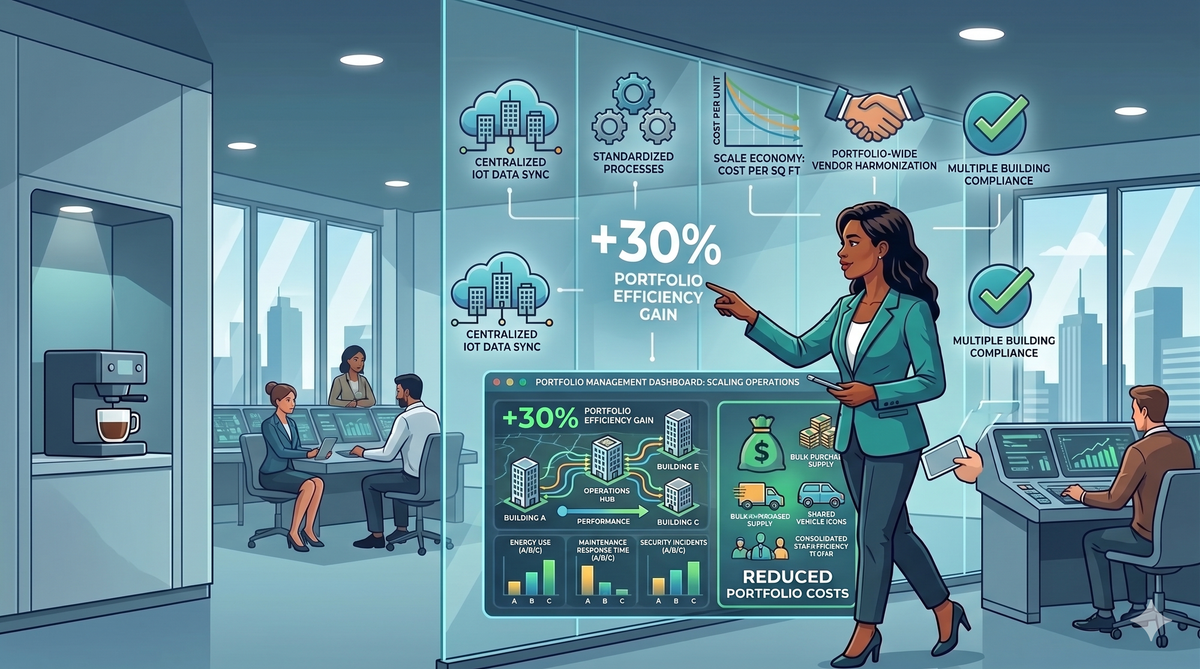
When operations are standardized, they become inspectable. A manager overseeing five buildings can look at the same set of indicators across all five and immediately identify which site is running well and which needs attention. Without standardization, each building becomes its own island with its own informal systems, and oversight requires physical presence.
Casalink is built around this principle: a unified system for assigning, verifying, and documenting operational tasks across multiple properties, with AI-reviewed photo evidence and location confirmation so that completion records reflect what actually happened rather than what was reported. For operators managing office portfolios across multiple sites or cities, this is the layer that makes scale operationally coherent.
The implementation path is straightforward. Start with one standardized checklist per service category. Apply it consistently. Build the evidence habit before adding volume. Scale what works.
The Commercial Opportunity in Getting This Right Early
The global facility management market is projected to grow from USD 61 billion in 2025 to USD 138 billion by 2030. Commercial office buildings represent the largest segment by revenue. The competitive dynamic over the next five years will favour operators who have built scalable, documented operations over those who scale headcount and hope the systems follow.
Institutional tenants, particularly those with offices across multiple cities or regions, are increasingly applying consistent evaluation criteria when selecting buildings. They want operational track records, clean CAM reconciliations, and documented service histories before committing to long-term leases. A portfolio that can demonstrate operational consistency across buildings commands a materially different conversation than one that cannot.
The operators who invest in that documentation infrastructure now are building a commercial advantage that compounds over time, independently of what the property market itself does.
Starting With the Process
The path to scale begins with a decision about process, made before the portfolio reaches the point where informal systems break down visibly.
Define what a completed service looks like, in evidence terms. Standardize how it gets documented. Apply that standard consistently across every building in the portfolio. Build the audit trail now, when the cost is low, so that it is available when a tenant renewal, a refinancing, or a new contract depends on it.
If you manage a commercial office portfolio and want to see how Casalink supports multi-site operational standardization, book a demo at casalink.app.